A story every healthcare provider knows
It’s Monday morning at a busy medical practice.
The waiting room is full. Phones are ringing. Staff members are juggling check-ins, insurance verifications, and appointment schedules. Everything seems to be running smoothly; until the billing manager opens the aging report.
Thirty, sixty, ninety days past due.
Patient balances are piling up.
Insurance paid its portion, but a growing share of revenue is now sitting in patient accounts; unpaid, disputed, or simply ignored. The care was delivered. The claim was processed. Yet the payment never arrived.
This is the reality of patient financial responsibility in today’s healthcare system.
The shift that changed everything
Not long ago, most providers relied heavily on insurance reimbursements. Patient payments were smaller, more predictable, and easier to collect.
Then high deductible health plans became the norm.
Today, patients are responsible for a larger share of their healthcare costs than ever before. Deductibles, copays, coinsurance, and non-covered services have turned patients into the largest payer group for many practices.
And unlike insurance companies, patients:
- Don’t always understand their bills
- Don’t budget for medical expenses
- Often feel surprised or overwhelmed
- May delay or avoid payment altogether
This shift has forced providers to rethink how they approach patient collections; not just as a billing task, but as a patient experience challenge.
Where collections often go wrong
Let’s go back to that practice.
Patients receive their bills weeks after their visit. The statements are filled with codes, abbreviations, and unclear totals. Some patients assume insurance hasn’t paid yet. Others think the bill is a mistake. A few intend to pay; but forget.
The practice sends another statement. Then another.
Eventually, the account becomes bad debt.
This isn’t because patients don’t want to pay. It’s because the process isn’t built for clarity, convenience, or communication.
Is Your Practice Struggling with Rising Patient Balances?
Don’t let unpaid deductibles and confusing statements drain your revenue. See how BillVolt streamlines the patient collection process so you get paid faster.
Strategy #1: Start the financial conversation early
The most successful collections don’t start after the visit; they start before care is delivered.
When patients know what to expect financially, anxiety goes down and payment rates go up.
What Works:
- Verifying insurance before the appointment
- Providing clear cost estimates
- Explaining deductibles and copays in simple terms
- Setting payment expectations upfront
Patients are far more willing to pay when there are no surprises.
Strategy #2: Make point-of-service payments the norm
One practice decided to change its approach.
Instead of waiting weeks to bill patients, they began requesting payment at check in or check out. Staff were trained to ask confidently; but respectfully.
The result?
Collection rates improved almost immediately.
Point of service collections:
- Reduce follow up billing costs
- Lower accounts receivable days
- Improve cash flow
- Prevent patient confusion later
When payment is handled while the visit is still fresh, it feels natural; not confrontational.
Strategy #3: Give patients flexible ways to pay
Patients live in a digital, on-demand world. Healthcare payments should reflect that reality.
Practices that offer multiple payment options consistently outperform those that don’t.
Flexible Payment Options Include:
- Online patient payment portals
- Mobile friendly billing
- Credit and debit cards
- ACH and bank transfers
- Interest free payment plans
Convenience isn’t a luxury; it’s a necessity.
Strategy #4: Tell a clear story through billing statements
A patient opens a bill and asks one simple question:
“Why do I owe this?”
If the bill can’t answer that clearly, payment gets delayed.
Effective billing statements:
- Use plain, patient-friendly language
- Clearly show what insurance paid
- Highlight the remaining balance
- Include simple instructions for how to pay
A clear bill builds trust. Trust leads to faster payments.
Strategy #5: Automate, but stay human
Automation doesn’t mean losing the personal touch; it means using technology to support it.
Automated billing systems can:
- Send timely payment reminders
- Deliver electronic statements
- Offer self-service payment options
- Reduce manual staff workload
The key is balance. Patients should feel informed, not harassed. Reminded, not pressured.
Strategy #6: Educate patients, don’t Aassume they know
Most patients aren’t avoiding payment; they are confused.
Education is one of the most powerful tools in improving patient financial responsibility.
Simple explanations about:
- How insurance works
- Why balances remain after insurance
- What payment options are available
can dramatically improve cooperation and collections.
Strategy #7: Lead with empathy
Healthcare is emotional. Financial stress only adds to it.
Practices that approach collections with empathy see better long term results.
That means:
- Offering payment plans
- Providing financial assistance when appropriate
- Training staff to communicate with compassion
- Avoiding aggressive collection tactics
Patients who feel respected are more likely to pay; and return to practice.
Technology’s role in modern patient collections
Technology has changed how providers manage patient financial responsibility.
Modern tools allow practices to:
- Estimate patient costs accurately
- Communicate digitally
- Accept payments anytime, anywhere
- Track patient balances in real time
When technology simplifies the process, everyone benefits.
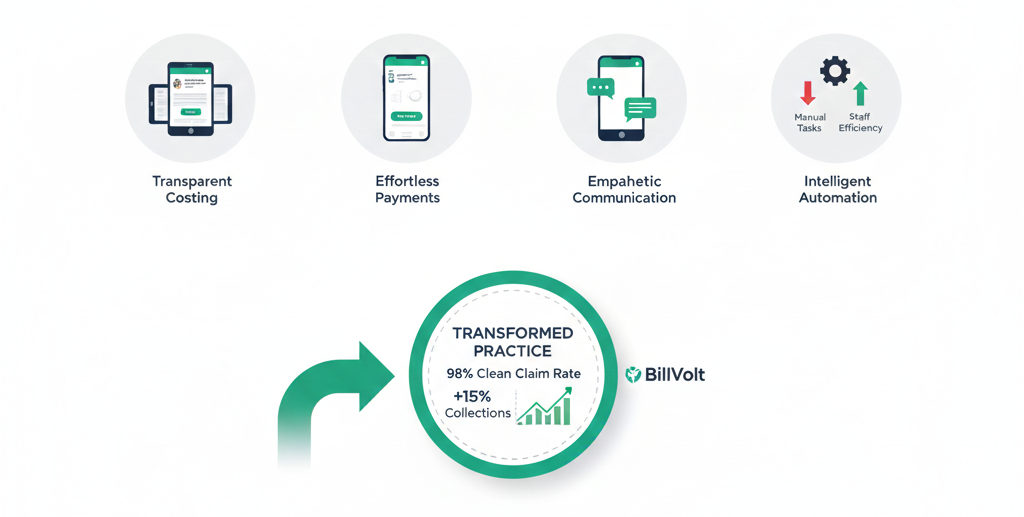
Bringing it all together
Back at that medical practice, things look different now.
Patient balances are lower. Payments arrive faster. Staff spend less time chasing unpaid bills. Patients feel informed instead of frustrated.
The care hasn’t changed; but the financial experience has.
That’s the real goal of effective patient financial responsibility strategies:
not just collecting what patients owe, but doing it in a way that supports trust, transparency, and long term success.
How BillVolt helps
At BillVolt, we help healthcare providers modernize patient billing and collections without sacrificing the patient experience.
Our solutions are built to:
- Improve patient payment rates
- Reduce accounts receivable
- Simplify billing workflows
- Support compassionate, compliant collections
Ready to improve patient payments without adding operational strain?
Contact us today and we will love to chat!