Every year, changes to the Current Procedural Terminology (CPT) code set require healthcare providers to take a closer look at their coding and billing processes. However, the 2027 CPT code updates deserve particular attention. They introduce significant changes across multiple medical specialties, including obstetrics, cardiovascular surgery, radiology, sleep medicine, and artificial intelligence-assisted healthcare services.
For medical practices, these changes are about much more than adding new codes to a billing system. They can affect how services are documented, how charges are captured, how claims are submitted, how insurance companies process those claims, and ultimately how quickly providers get paid.
Consider a practical example.
An obstetrics practice begins January 2027 using the same global maternity billing workflow it followed throughout 2026. Its billing team continues submitting claims using familiar global obstetric codes, without accounting for the new reporting structure. Those claims may be rejected because the previously used codes are no longer valid for dates of service beginning January 1, 2027.
Now consider a radiology group that has not updated its charge master, a sleep medicine practice that is unfamiliar with the new unattended sleep study codes, or a surgical group whose documentation templates do not capture the details needed to support the revised procedure codes.
In each situation, the consequences can extend beyond an isolated coding error. They can lead to claim rejections, delayed reimbursement, additional administrative work, increased accounts receivable (A/R), and unnecessary pressure on the practice’s revenue cycle.
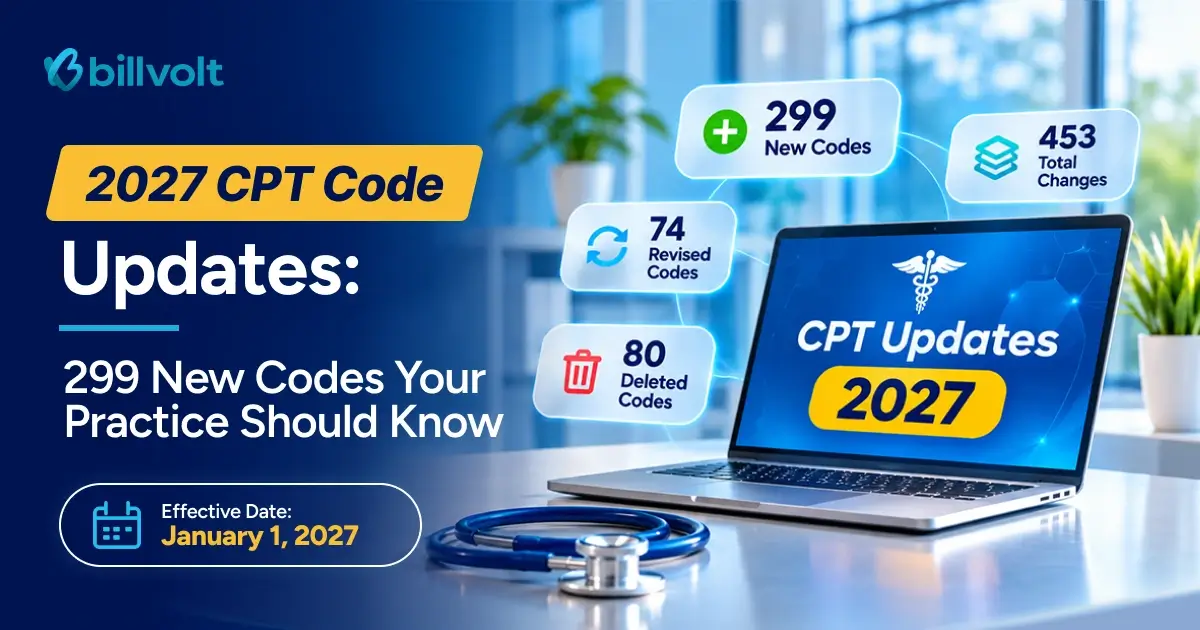
The American Medical Association (AMA) has announced 453 editorial changes to the 2027 CPT code set, including:
| Type of change | Number |
| New CPT codes | 299 |
| Revised CPT codes | 74 |
| Deleted CPT codes | 80 |
| Total editorial changes | 453 |
Most of the 2027 CPT code changes become effective January 1, 2027.
For physicians, practice administrators, and medical billing companies, the priority should be understanding which changes apply to their specialties and ensuring that coding, documentation, EHR systems, payer policies, and billing workflows are ready before implementation.
In this guide, we break down the most important 2027 CPT coding changes, explain their potential impact on different medical specialties, and outline the steps healthcare practices should take to protect their revenue cycle.
What Are CPT Codes and Why Do Annual Updates Matter?
Current Procedural Terminology (CPT) codes are standardized five-digit codes used to describe medical, surgical, diagnostic, and other professional healthcare services performed by physicians and qualified healthcare professionals in the United States.
The AMA maintains the CPT code set through an established editorial process involving physicians, medical specialty organizations, healthcare experts, and other stakeholders.
CPT codes play a central role in the healthcare reimbursement process. They help communicate what service was performed, establish a standardized language between providers and payers, and support claims processing, payment policies, healthcare analytics, and quality measurement.
However, CPT codes do not operate independently.
A procedure code must be supported by appropriate clinical documentation, relevant diagnosis information, applicable modifiers, and the payer’s billing and coverage requirements. The place of service, provider qualifications, contractual arrangements, and applicable coding guidelines may also affect how a service should be reported.
This is why annual CPT updates require a coordinated approach involving:
- Physicians and clinical staff responsible for documenting services.
- Medical coders responsible for selecting appropriate procedure codes.
- Charge entry teams responsible for translating completed services into billable charges.
- Medical billing specialists responsible for claim preparation and submission.
- Practice administrators responsible for overseeing financial performance.
- EHR and practice management vendors responsible for maintaining updated code libraries and billing functionality.
A code update that is overlooked at any one of these stages can create problems further down the revenue cycle.
What’s New in the 2027 CPT Code Set?
The 2027 CPT code changes reflect developments in medical technology, evolving clinical practices, and the need for more precise reporting of healthcare services.
While some changes introduce entirely new codes, others revise existing descriptions, modify coding guidelines, or eliminate codes that no longer adequately represent current clinical practices.
The most notable areas of change include:
- A major restructuring of maternity care coding.
- New cardiovascular and left ventricular assist device procedure codes.
- Expanded coding options for diaphragmatic hernia repair.
- Updated prostate biopsy coding guidelines.
- New time-based biofeedback codes.
- Changes to radiology and magnetic resonance angiography reporting.
- New unattended sleep study codes.
- Expanded CPT coding for artificial intelligence-assisted medical services.
Let’s look at what these changes mean for the affected specialties.
1. Maternity Care: A Major Restructuring of Obstetric Billing
<text>Effective January 1, 2027</text>
One of the most significant changes in the 2027 CPT code set involves maternity care services.
For decades, obstetric practices have relied heavily on global maternity care codes that bundle multiple phases of pregnancy-related services into a single billing structure.
Traditionally, global obstetric billing has allowed practices to report a comprehensive package covering antepartum care, delivery, and postpartum care, provided the applicable requirements are met.
However, modern obstetric care does not always follow a single-provider, single-practice model.
Patients may receive prenatal care from one physician, be transferred to another hospital or obstetric group for delivery, and receive postpartum services from a different clinician. Telehealth, changes in care plans, high-risk pregnancies, and evolving team-based care arrangements have also made the traditional global billing structure less representative of how services are delivered.
To address these challenges, the AMA has approved a major restructuring of maternity care CPT codes for 2027.
How Will Maternity Care Billing Change?
Beginning January 1, 2027, maternity care reporting will move toward a more detailed, phase-specific structure.
The four major components are:
A. Antepartum Care (Prenatal Services)
Rather than relying on the traditional global maternity structure, antepartum encounters will generally be reported using the appropriate Evaluation and Management (E/M) codes for each encounter.
Code selection will depend on the applicable E/M guidelines, including the location of the service and medical decision-making or time requirements.
This is an important operational change for OB/GYN practices because prenatal encounters will need to be tracked and billed individually under the new structure.
B. Labor Management
The 2027 CPT code set introduces four new labor management codes:
| CPT code | Description |
| 59080 | Initial day labor management – straightforward |
| 59081 | Initial day labor management – complex |
| 59082 | Subsequent day labor management – straightforward |
| 59083 | Subsequent day labor management – complex |
These codes distinguish between initial and subsequent days of labor management, as well as straightforward and complex management.
Documentation will become particularly important when determining the appropriate complexity level.
For example, the straightforward category has specific clinical criteria, including singleton vertex presentation, routine maternal and fetal monitoring, normal progression or routine induction/augmentation, stable medical conditions, and no prior cesarean.
Practices should not assume that every labor management service qualifies for the same code. The actual clinical circumstances and documentation must support the code selected.
C. Delivery Services
The updated code set introduces separate reporting options for vaginal and cesarean deliveries.
New codes include:
| CPT code | Description |
| 59431 | Vaginal delivery, with or without episiotomy |
| 59432 | Vaginal delivery following previous cesarean |
| 59502 | Primary cesarean delivery |
| 59503 | Repeat cesarean delivery |
These codes incorporate specific components of the delivery service, including delivery of the placenta and certain routine services.
The updated structure also addresses the reporting of labor management when applicable to a delivery encounter.
D. Postpartum Care
Postpartum services will also follow a more detailed reporting structure.
Routine same-day postpartum care is included in the applicable delivery code. Subsequent inpatient postpartum care will generally be reported using the appropriate hospital E/M services, while outpatient postpartum encounters will be reported using applicable E/M codes.
This makes accurate encounter tracking and documentation essential throughout the patient’s postpartum care.
What Does This Mean for OB/GYN Practices?
The maternity care changes require more than updating a few procedure codes.
OB/GYN practices should review:
- How prenatal visits are documented and charged.
- How labor management services are captured.
- How vaginal and cesarean deliveries are reported.
- How postpartum visits are scheduled, documented, and billed.
- How services are divided when multiple physicians or groups participate in patient care.
- How claims are handled when a pregnancy spans the 2026 and 2027 calendar years.
- Whether payer contracts and fee schedules still reference deleted global maternity codes.
An especially important consideration is the 2026-to-2027 transition.
Practices must distinguish between services performed in 2026 and services performed on or after January 1, 2027. The new reporting rules do not retroactively change how 2026 services should be coded.
For patients whose pregnancies span both calendar years, the practice must follow the applicable transition guidance rather than automatically applying one billing method to the entire pregnancy.
The AMA has published detailed guidance for these scenarios, and practices should review it before finalizing their obstetric billing workflows.
2. Cardiovascular Procedures and Left Ventricular Assist Devices (LVADs)
The 2027 CPT updates also introduce changes involving ventricular assist device procedures.
Three new codes involving left ventricular assist devices (LVADs) have been introduced, along with revised guidelines intended to improve the reporting of these procedures.
LVADs are mechanical devices used to support cardiac function in patients with advanced heart failure. Their implantation, management, and related procedures involve highly specialized clinical services and documentation.
For cardiovascular and cardiothoracic surgical practices, accurate reporting requires a clear understanding of the specific procedure performed and the applicable CPT guidelines.
What Should Cardiovascular Practices Review?
Practices should evaluate:
- Updated CPT descriptors and reporting guidelines.
- Operative documentation and procedure details.
- Physician and qualified healthcare professional documentation.
- Charge capture workflows for applicable LVAD procedures.
- Relevant payer policies and reimbursement requirements.
- Whether existing billing software correctly supports the updated codes.
For complex cardiovascular procedures, selecting a code based solely on the general procedure name is not sufficient. The documentation must support the actual service performed and the specific reporting requirements.
3. Hernia Repair: Nine New Diaphragmatic Hernia Codes
The 2027 CPT code set introduces nine new codes for diaphragmatic hernia repairs.
These additions expand reporting options for traumatic and nontraumatic diaphragmatic hernia procedures performed through different surgical approaches, including:
- Open procedures.
- Laparoscopic procedures.
- Thoracoscopic procedures.
The distinction between surgical approaches is important because the updated coding structure provides more specific ways to describe the procedure performed.
What Does This Mean for Surgical Practices?
Surgeons and coding teams should pay close attention to operative reports.
Documentation should clearly establish the type of hernia, whether it is traumatic or nontraumatic where relevant, and the surgical approach used.
For example, simply documenting that a diaphragmatic hernia repair was performed may not provide sufficient detail to support accurate code selection when the available codes distinguish between different approaches.
Surgical practices should review their operative note templates, coding references, and charge capture processes before the new codes take effect.
4. Radiology and Prostate Biopsy Coding Changes
Radiology and urology practices should also review the 2027 CPT updates carefully.
The new code set includes changes to prostate biopsy reporting and radiology coding, including updates to magnetic resonance angiography (MRA) reporting for the head and neck.
These revisions are intended to better reflect contemporary diagnostic techniques and improve the specificity of procedure reporting.
Implications for Radiology Groups
Radiology billing involves several considerations beyond selecting the correct procedure code.
Depending on the service and applicable payer rules, practices may need to account for:
- Professional and technical components.
- Global billing arrangements.
- Place of service.
- Modifiers.
- Medical necessity.
- Ordering provider information.
- Authorization requirements.
- Payer-specific coverage policies.
For example, a change in radiology code descriptions or reporting instructions may require corresponding updates to a group’s charge master, EHR procedure catalog, and claim validation rules.
Practices should also verify whether their existing authorization workflows recognize the updated procedure codes.
Implications for Urology Practices
The prostate biopsy updates make it important for urology practices to review how biopsy services are documented and reported.
Coding teams should compare the actual techniques used by their physicians against the updated CPT descriptions and guidelines.
They should also review applicable bundling rules and payer policies before assuming that a newly available code can be reported separately or reimbursed independently.
5. Sleep Medicine: Six New Codes for Unattended Sleep Studies
Sleep medicine is another specialty affected by the 2027 CPT updates.
Six new codes have been introduced for unattended sleep studies, reflecting advances in diagnostic technology and the growing use of sleep testing outside traditional sleep centers.
Unattended sleep testing can be an important component of evaluating patients for sleep-related breathing disorders, including obstructive sleep apnea.
As home-based diagnostic testing becomes more widely integrated into clinical workflows, accurate reporting of the services performed becomes increasingly important.
What Should Sleep Centers and Sleep Medicine Practices Do?
Practices should review:
- The new unattended sleep study code descriptions.
- The specific testing services performed.
- Documentation supporting the diagnostic service.
- Technical and professional billing arrangements, where applicable.
- Ordering and interpreting provider requirements.
- Payer-specific coverage and medical necessity criteria.
- Authorization requirements for sleep diagnostic testing.
A particularly important consideration is that the introduction of a new CPT code does not automatically establish coverage by Medicare or commercial insurance plans.
Sleep centers should verify payer policies and reimbursement requirements before incorporating new codes into their billing workflows.
6. Artificial Intelligence (AI) and Emerging Medical Technologies
Artificial intelligence is becoming increasingly integrated into healthcare delivery.
AI-enabled technologies are being used in areas such as diagnostic imaging, clinical decision support, data analysis, and other healthcare applications.
Recognizing the growing role of these technologies, the AMA has introduced 10 additional AI-related CPT codes for 2027, bringing the total number of AI-related CPT codes to 43.
The AMA has also refined its AI taxonomy to better describe how artificial intelligence supports or assists healthcare professionals.
This is an important development because AI-related clinical services can involve different levels of professional involvement, technology integration, and clinical responsibility.
Does Using an AI Tool Automatically Make a Service Separately Billable?
No.
This is an important distinction for healthcare providers.
Simply using an AI-powered application, software platform, or diagnostic tool does not automatically establish that a separately reportable or reimbursable service has been performed.
The service must meet the applicable CPT descriptor and reporting requirements, and the documentation must support the work performed.
Practices should evaluate:
- What clinical service was actually performed.
- Whether the service meets the applicable CPT definition.
- The role of the physician or qualified healthcare professional.
- Required clinical documentation.
- Whether the service is separately reportable.
- Applicable payer coverage and reimbursement policies.
Healthcare organizations investing in AI-assisted clinical technologies should involve their coding and compliance teams early in the implementation process.
7. Biofeedback: A New Time-Based Coding Structure
The 2027 CPT code set also introduces a new time-based coding structure for biofeedback services.
The revised framework is intended to better align reporting with how biofeedback training is commonly delivered.
For practices offering biofeedback services, this means reviewing how time is documented, how individual sessions are captured, and how charges are translated into claims.
Billing teams should pay attention to the applicable code descriptors, time requirements, documentation guidelines, and payer policies.
Where time-based reporting applies, accurate recording of the service duration and the work performed is essential. Practices should not assume that their existing charge entry methods will automatically satisfy the updated requirements.
How the 2027 CPT Code Changes Can Affect Your Medical Practice’s Revenue Cycle
Understanding the code changes is only one part of the process. The larger concern for healthcare organizations is how these updates affect the entire revenue cycle.
A medical claim moves through several stages before payment is received. These typically include patient registration, insurance verification, authorization when required, clinical documentation, charge capture, coding, claim submission, payer adjudication, payment posting, denial management, and accounts receivable follow-up.
A problem introduced at the coding stage can affect every subsequent step.
Here are some of the most common financial and operational risks associated with an incomplete CPT transition.
1. Increased Claim Rejections and Denials
Using deleted CPT codes for dates of service on or after their effective deletion date can result in rejected claims.
Similarly, selecting an incorrect replacement code, overlooking revised reporting instructions, or submitting claims without sufficient supporting documentation can create avoidable billing problems.
Practices should distinguish between front-end claim rejections and payer denials.
A rejection may indicate that a claim failed an initial formatting or validation requirement, while a denial generally reflects a payer’s decision not to reimburse a submitted service, either fully or partially.
Both require timely resolution, but the corrective action may be different.
2. Delayed Reimbursement and Increased Days in A/R
When claims are rejected or denied because of coding errors, billing teams must investigate the issue, review documentation, make appropriate corrections, and resubmit or appeal the claim when warranted.
This adds unnecessary steps to the reimbursement process.
For practices submitting hundreds or thousands of claims every month, even a relatively small increase in coding-related errors can create a meaningful backlog.
The result may be an increase in:
- Days in accounts receivable.
- Claims pending correction.
- Unresolved insurance balances.
- Denied claims awaiting appeal.
- Staff time spent on rework.
3. Incorrect Payments and Underpayments
Not every billing problem results in a complete denial.
In some cases, claims may be processed but reimbursed incorrectly because of outdated fee schedules, payer-specific coding edits, incorrect modifiers, or contractual payment rules.
For this reason, practices should not consider a claim successfully resolved simply because the payer issued a payment.
Payment posting and reconciliation should include a review of expected versus actual reimbursement.
For affected procedures, billing teams should compare payer remittances against applicable contractual fee schedules and investigate discrepancies.
4. Increased Administrative Costs
Every corrected claim requires additional work.
Staff may need to review the medical record, verify the code, communicate with the provider, contact the payer, correct the claim, and monitor the resubmission.
When coding changes are not implemented correctly, this additional workload can become a recurring operational expense.
A well-managed revenue cycle should focus on preventing avoidable errors rather than repeatedly correcting them after claims have been submitted.
5. Potential Compliance and Audit Risks
Incorrect coding is not only a reimbursement concern.
Repeated use of invalid codes, unsupported procedure reporting, inappropriate code combinations, or documentation that does not substantiate billed services may increase compliance exposure.
Healthcare organizations should maintain appropriate coding oversight, conduct periodic reviews, and ensure that billing practices remain consistent with applicable CPT guidelines and payer requirements.
The objective is accurate reimbursement for services actually performed, supported by appropriate documentation.
8. CPT Coding Changes vs. Medicare and Commercial Payer Reimbursement: An Important Distinction
One of the most common misunderstandings surrounding annual CPT updates is the assumption that a new CPT code automatically means a new reimbursement opportunity.
That is not necessarily the case.
The AMA maintains the CPT code set, while CMS establishes Medicare payment policies and reimbursement rates under the applicable Medicare Physician Fee Schedule.
Commercial insurance companies, Medicaid programs, and other payers may have their own coverage policies, reimbursement methodologies, and claims processing requirements.
Consequently, the introduction of a new CPT code does not automatically mean that:
- Medicare will cover the service.
- Every commercial payer will recognize the code immediately.
- The service will receive separate reimbursement.
- An existing authorization will automatically apply to the new code.
- The reimbursement amount will be the same across insurance plans.
Practices should review the applicable 2027 Medicare Physician Fee Schedule, payer fee schedules, coverage determinations, contractual terms, and payer communications.
For Medicare claims, it is also important to distinguish between CPT code changes and changes to relative value units (RVUs), conversion factors, and other payment policies.
These are related but separate components of the reimbursement process.
A compliant billing operation must understand both how a service should be coded and how the applicable payer intends to process and reimburse it.
9. Eight Practical Steps to Prepare Your Practice for the 2027 CPT Updates
Preparing for annual coding changes should be a structured process, not a last-minute software update.
The following steps can help medical practices reduce implementation problems and protect their revenue cycle.
Step 1: Identify the CPT Codes Your Practice Actually Uses
Start by reviewing your practice’s historical billing data.
Pull claims from the previous 6–12 months and identify:
- Your highest-volume CPT codes.
- Procedures affected by the 2027 changes.
- Codes being deleted or revised.
- Services associated with frequent denials.
- Procedures with significant reimbursement value.
- Codes frequently requiring manual corrections.
A specialty-specific review is more useful than attempting to review all 299 new codes with equal priority.
The goal is to identify the changes that can actually affect your practice.
Step 2: Review and Update Your Charge Master
Your charge master is a critical component of the billing process.
It connects the services performed by your providers to the codes, charges, and billing information used to generate claims.
Review the charge master to ensure that:
- Deleted codes are addressed appropriately.
- New codes are available when applicable.
- Revised code descriptions are updated.
- Charge amounts are reviewed.
- Relevant modifiers are configured.
- Code combinations and billing edits are reviewed.
This is especially important for practices with multiple providers, locations, specialties, or tax identification numbers.
Step 3: Coordinate With Your EHR and Billing Software Vendor
Updating CPT codes in a reference library is not necessarily the same as updating the entire billing workflow.
Your EHR and practice management system should be reviewed for:
- Updated CPT code libraries.
- Superbills and encounter templates.
- Procedure and order catalogs.
- Charge entry configurations.
- Claim scrubbing rules.
- Automated coding edits.
- Clearinghouse compatibility.
- Historical date-of-service processing.
Ask your software vendor when the 2027 code updates will be available and whether any manual configuration or additional implementation steps are required.
Also verify that the system selects the appropriate code set based on the date of service.
For example, a claim submitted in February 2027 for a service performed in December 2026 should generally follow the applicable 2026 coding requirements, not automatically use the 2027 code set.
Step 4: Review Clinical Documentation Requirements
Accurate coding begins with accurate clinical documentation.
Physicians and clinical staff should understand what information needs to be captured to support the new or revised codes.
For affected specialties, review documentation templates and determine whether additional fields or more detailed descriptions are necessary.
For example:
- OB/GYN practices should review documentation for prenatal visits, labor management, delivery, and postpartum services.
- Surgical practices should ensure that operative reports clearly identify the procedure and surgical approach.
- Sleep medicine practices should maintain appropriate documentation for unattended diagnostic testing.
- Radiology practices should review documentation supporting the specific imaging service reported.
- Practices using AI-assisted clinical services should establish clear documentation of the service and professional involvement.
Coding accuracy should never depend on assumptions or information that is not supported by the medical record.
Step 5: Verify Payer Policies and Reimbursement Requirements
This step is frequently overlooked.
Even when a code is valid under the 2027 CPT code set, insurance companies may have different implementation timelines, coverage policies, billing edits, and reimbursement requirements.
Practices should review:
- Medicare guidance and applicable fee schedules.
- Medicare Administrative Contractor (MAC) instructions.
- Medicaid program requirements.
- Commercial payer bulletins.
- Contractual fee schedules.
- Medical necessity criteria.
- Prior authorization requirements.
- Modifier and bundling policies.
Where necessary, contact payer representatives to clarify how affected services should be reported and reimbursed.
Do not assume that all payers will implement every change identically.
Step 6: Train Physicians, Coders, and Billing Staff
Annual CPT changes should be communicated to everyone involved in the clinical and billing workflow.
This includes physicians, advanced practice providers, medical assistants, coding specialists, charge entry personnel, and billing managers.
Training should focus on actual services performed by the practice rather than generic code descriptions alone.
Use practical documentation examples to explain:
- Which codes are changing.
- Which codes are being deleted.
- What documentation is required.
- How replacement codes should be selected.
- Which payer-specific issues need attention.
- How claims should be corrected when errors are identified.
A well-trained billing team can identify problems before claims reach the payer.
Step 7: Perform Pre-Implementation Testing
Before January 1, practices should test their updated billing workflows.
Where possible, use sample encounters and claims to confirm that the EHR, practice management system, and clearinghouse are handling the updated code set correctly.
Testing should include:
- New code availability.
- Deleted code handling.
- Revised code descriptions.
- Modifier configurations.
- Claim validation edits.
- Date-of-service logic.
- Payer-specific claim requirements.
This is particularly important for larger organizations with multiple locations, providers, and billing teams.
Step 8: Monitor Billing KPIs After Implementation
The implementation process should not end once the new codes become available.
During January and February 2027, practices should closely monitor their billing performance to identify problems early.
Important revenue cycle KPIs include:
| KPI | What to monitor |
| First-pass claim acceptance rate | Percentage of claims accepted without initial rejection |
| Clean claim rate | Percentage of claims submitted without preventable errors |
| Initial denial rate | Percentage of claims denied on initial adjudication |
| Days in A/R | Average time outstanding insurance balances remain unpaid |
| A/R aging | Claims outstanding in 30-, 60-, 90-, and 120-plus-day categories |
| Net collection rate | Percentage of collectible revenue actually collected |
| Denial overturn rate | Percentage of appealed denials successfully reversed |
| Payment variance | Difference between expected and actual reimbursement |
Pay particular attention to CPT-related rejections, changes in reimbursement patterns, and recurring errors involving new, revised, or deleted codes.
A sudden increase in denials for one procedure category may indicate a problem with code selection, documentation, payer configuration, or software implementation.
The sooner these trends are identified, the easier it is to correct them before they affect a larger volume of claims.
10. Why Accurate Medical Coding Requires More Than an Updated Codebook
One of the biggest mistakes healthcare organizations make is treating medical coding as an isolated administrative function.
In reality, coding is closely connected to nearly every stage of the revenue cycle.
A service must be properly documented before it can be coded accurately. The charge must be captured correctly before a claim can be generated. The claim must meet payer requirements before it can be processed successfully. And payment must be monitored to ensure that the provider receives the reimbursement to which they are contractually entitled.
Consider what happens when one part of this process breaks down:
- A physician performs a service but the documentation is incomplete.
- The coding team cannot confidently support the appropriate CPT code.
- The charge entry team submits an incorrect or incomplete charge.
- The claim passes through an automated billing workflow without the necessary correction.
- The payer rejects or denies the claim.
- The billing team must investigate and correct the issue.
- The payment is delayed, increasing the practice’s outstanding A/R.
This is why experienced medical billing and coding professionals must understand more than the code itself.
They need to understand the clinical service, documentation requirements, coding guidelines, payer policies, claim submission rules, and reimbursement process.
A strong medical billing operation should be proactive, not simply reactive.
11. How BillVolt Helps Healthcare Practices Manage Medical Coding and Billing Changes
Keeping up with annual CPT code changes is only one of the many responsibilities involved in running a successful medical practice.
Physicians and practice administrators already have to manage patient care, staffing, insurance requirements, credentialing, compliance, and day-to-day operations. Managing an increasingly complicated billing environment on top of these responsibilities can put considerable pressure on internal administrative teams.
This is where having an experienced medical billing and revenue cycle management partner can make a meaningful difference.
At BillVolt, we work with healthcare organizations across multiple specialties to manage their revenue cycle, improve billing accuracy, and help practices maintain a more consistent reimbursement process.
Our approach goes beyond submitting insurance claims. We look at the entire revenue cycle, from the initial patient encounter through final payment and accounts receivable resolution.
Comprehensive Medical Billing and Revenue Cycle Management
Our medical billing services cover the key stages of the revenue cycle, including:
Patient Eligibility and Insurance Verification
Verifying patient insurance coverage, identifying potential eligibility issues, and helping practices address coverage-related problems before services are performed.
Charge Entry and Medical Coding Support
Reviewing charges, supporting accurate CPT and ICD-10 reporting, identifying coding discrepancies, and ensuring that claims are prepared in accordance with applicable billing requirements.
Claims Submission and Management
Preparing and submitting electronic claims, monitoring clearinghouse responses, and addressing rejections before they create unnecessary delays.
Denial Management and Appeals
Investigating denied claims, identifying underlying issues, correcting billing errors when appropriate, and pursuing appeals when supported by documentation and payer requirements.
Accounts Receivable Management
Following up on outstanding insurance balances, researching unpaid claims, resolving payment discrepancies, and working to reduce aging A/R.
Payment Posting and Reconciliation
Posting insurance payments and adjustments, reviewing explanation of benefits (EOBs) and electronic remittance advice (ERAs), and identifying underpayments or discrepancies that require further investigation.
Credentialing and Provider Enrollment
Assisting healthcare practices with provider credentialing, payer enrollment, and related administrative requirements to support participation with insurance networks.
A Revenue Cycle Approach That Goes Beyond Claim Submission
At BillVolt, we believe that successful medical billing is not measured simply by the number of claims submitted.
A practice needs visibility into what happens after those claims reach the insurance company.
Are claims being accepted on the first submission? Are payers reimbursing according to contracted rates? Are denials being addressed promptly? Is the practice accumulating older insurance balances? Are recurring coding issues being identified and corrected?
These are the questions that matter when evaluating the overall health of a medical practice’s revenue cycle.
Our team works with practices to monitor important billing performance indicators, identify operational gaps, and address issues that may affect collections.
We also recognize that different specialties have different billing requirements. A behavioral health practice, an orthopedic group, a radiology organization, and an ambulatory surgery center do not have identical coding or reimbursement workflows.
That is why our approach focuses on the specific services, payer mix, documentation practices, and operational requirements of each organization.
Whether your practice needs assistance navigating the 2027 CPT changes or wants to improve its overall billing performance, BillVolt can help.
Contact BillVolt to schedule a free consultation and discuss how our medical billing and revenue cycle management services can support your practice.
Prepare for the 2027 CPT Changes Before They Affect Your Revenue
The 2027 CPT code updates represent more than another annual revision to the medical coding system.
With 299 new codes, 74 revised codes, and 80 deleted codes, the changes introduce important considerations for healthcare organizations across multiple specialties.
The restructuring of maternity care billing alone will require significant attention from OB/GYN practices. Meanwhile, new codes for sleep medicine, cardiovascular procedures, hernia repairs, and AI-assisted healthcare services will require affected organizations to review their existing documentation and billing workflows.
For healthcare practices, the real challenge is not simply understanding what has changed. It is ensuring that those changes are implemented correctly throughout the revenue cycle.
Practices that review their coding processes, update their billing systems, train their teams, verify payer requirements, and monitor reimbursement trends will be better positioned to navigate the transition.
Waiting until claims begin getting rejected is not a sound implementation strategy.
The best time to prepare for coding changes is before they start affecting your claims and collections.
If your practice needs help with medical coding, billing, denial management, or comprehensive revenue cycle management, BillVolt is here to help.
Visit BillVolt to learn more about our services or schedule a free consultation.
Frequently Asked Questions About the 2027 CPT Code Update
1. When do the 2027 CPT code changes take effect?
Most of the 2027 CPT code updates become effective January 1, 2027. Healthcare providers should use the applicable code set based on the date of service and follow any specific implementation guidance issued by the AMA or relevant payers.
2. How many new CPT codes are being introduced in 2027?
The AMA has announced 299 new CPT codes for 2027, along with 74 revised codes and 80 deleted codes. This represents 453 total editorial changes.
3. Which medical specialties are most affected by the 2027 CPT updates?
Some of the major areas affected include:
- Obstetrics and gynecology.
- Cardiovascular and cardiothoracic surgery.
- General and surgical specialties performing diaphragmatic hernia repairs.
- Radiology.
- Urology.
- Sleep medicine.
- Biofeedback services.
- Healthcare organizations using qualifying AI-assisted clinical services.
The specific impact will depend on the services performed and the CPT codes used by each practice.
4. What is the biggest change to maternity care billing in 2027?
The traditional global maternity care coding structure is being replaced with a more detailed reporting framework covering antepartum care, labor management, delivery, and postpartum services.
Prenatal and postpartum encounters will generally use applicable E/M codes, while new codes will describe labor management and delivery services.
This change requires OB/GYN practices to review their documentation, charge capture, and billing workflows.
5. Will the old global maternity codes still be valid in 2027?
The deleted global maternity codes will no longer be valid for dates of service on or after January 1, 2027.
Practices must follow the new reporting structure for applicable 2027 services. Claims for services performed in 2026 should continue to follow the applicable 2026 CPT guidelines.
6. Are there new CPT codes for sleep studies in 2027?
Yes. Six new codes have been introduced for unattended sleep studies. These changes reflect developments in diagnostic technology and the growing use of sleep testing outside traditional sleep centers.
Sleep medicine practices should review the new code descriptions, documentation requirements, and applicable payer coverage policies.
7. What are the new AI-related CPT codes for 2027?
The 2027 CPT code set introduces 10 additional AI-related codes, bringing the total number of AI-related CPT codes to 43.
The updated AI taxonomy provides a more structured way to describe artificial intelligence services that support or assist healthcare professionals.
Using AI technology alone does not automatically establish that a separately billable service has been performed.
8. Do new CPT codes automatically mean higher reimbursement?
No. The introduction of a new CPT code does not automatically establish coverage or a specific reimbursement amount.
Medicare, Medicaid, and commercial insurance companies may have different coverage policies, fee schedules, payment methodologies, and reporting requirements.
Practices should verify the applicable payer policies before billing newly introduced codes.
9. Can outdated CPT codes cause claim denials?
Yes. Using deleted codes, selecting incorrect procedure codes, overlooking revised reporting guidelines, or failing to meet documentation requirements can result in claim rejections, denials, or delayed reimbursement.
Practices should update their billing systems and monitor claims closely after implementation.
10. What should medical practices do before January 1, 2027?
Practices should review frequently used CPT codes, identify affected procedures, update their EHR and practice management systems, review documentation templates, verify payer policies, train billing staff, and test claim submission workflows.
They should also establish a process for monitoring claim acceptance, denial rates, payment variances, and A/R performance after implementation.
11. How can a medical billing company help with the 2027 CPT changes?
An experienced medical billing company can help practices review affected codes, identify potential billing issues, support accurate charge capture, monitor claim submissions, manage denials, and investigate reimbursement discrepancies.
A comprehensive revenue cycle management partner can also help practices monitor billing KPIs and identify recurring problems that may affect collections.
12. Why should a medical practice consider outsourcing revenue cycle management?
Outsourcing medical billing and revenue cycle management can give practices access to experienced billing professionals, established workflows, payer follow-up resources, and ongoing performance monitoring.
It can also reduce the administrative burden on internal staff, allowing physicians and practice administrators to focus more attention on patient care and practice operations.
Authoritative References and Further Reading
- American Medical Association – 2027 CPT Code Set Announcement
- Centers for Medicare & Medicaid Services – 2027 Medicare Physician Fee Schedule Final Rule
Editorial note: CPT is a registered trademark of the American Medical Association. CPT code descriptions and guidelines are subject to AMA copyright. Practices should consult the official CPT 2027 Professional Edition and applicable payer guidance before implementing coding changes. This article is for educational purposes and is not a substitute for individualized coding, compliance, or reimbursement advice.